
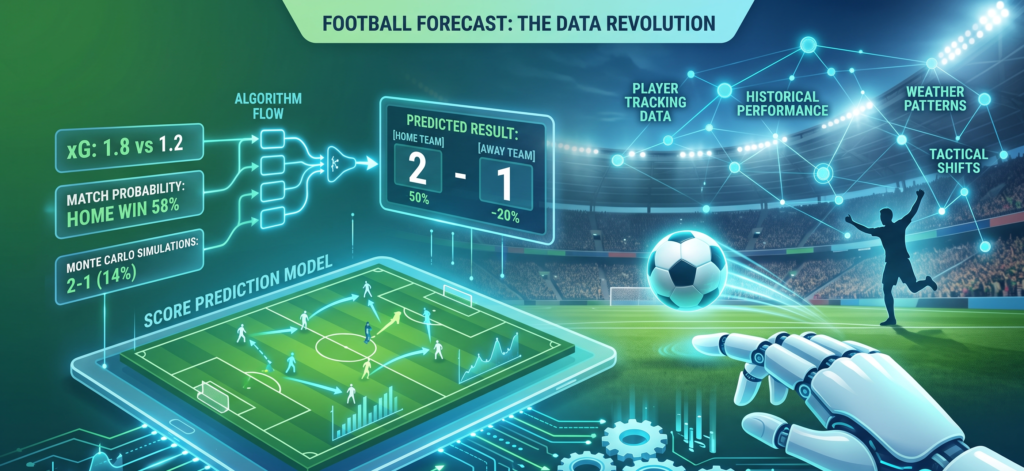
We’ve all been there: ninety minutes on the clock, a fierce rivalry on the pitch, and a game that could turn on a single breath. Football is celebrated for its glorious, heart-stopping unpredictability—the last-second equalizer, the dramatic underdog victory, or the cruel deflection off a defender’s boot.
But beneath the raw emotion and chaotic energy of the stadium lies a hidden world of numbers.
In recent years, data scientists and sports tech companies have started trading in their gut instincts for something much more precise: Artificial Intelligence (AI) and Machine Learning (ML). What was once the domain of casual pub debates has transformed into a high-tech computational race.
But how exactly does AI cut through the chaos to predict a football scoreline? Let’s dive into how data feeds are structured, analyzed, and transformed into statistical insights.
Moving Beyond Basic Stats
In the past, predicting a football match meant looking at a few basic variables: Who won the last head-to-head? What is each team’s average goals-per-game?
AI completely reframes this approach by looking at the entire picture at once. Modern machine learning algorithms don’t just look at wins and losses; they swallow massive, multi-dimensional datasets. Raw sporting statistics are often ingested through pipeline architectures like those explored at vertexdatatransformation.com, allowing researchers to turn unstructured player tracking coordinates into structured model training features.
According to a comprehensive Sports AI Machine Learning Guide, today’s models track nuanced variables like:
- Expected Goals ($xG$): The quality of scoring chances created, rather than just the shots that went in.
- Final Third Efficiency: Passing accuracy and ball retention in the opponent’s critical defensive zones.
- Physical Metrics: Player fatigue levels and recovery speeds tracked via wearable GPS vests.
- Environmental Factors: Historical performance under high humidity, extreme cold, or specific away-stadium pressures.
By analyzing thousands of historical matches against these variables, an AI model can spot invisible patterns. For instance, it might discover that a certain team concedes 35% more goals from set-pieces on rainy away games when their primary center-back has played more than 180 minutes in the previous week.
The Engine Under the Hood: How the Models Work
To generate a precise scoreline prediction, data scientists don’t rely on just one formula. Instead, they use an ensemble method—combining multiple specialized algorithms to get the clearest picture.
- Poisson Distribution Models: This acts as the foundational layer. As documented in research published via MDPI’s Applied Sciences journal, Poisson regression allows analysts to calculate the mathematical probability of a specific number of events (goals) occurring within a fixed timeframe based on a team’s historically calculated attacking and defensive strengths.
- Gradient Boosted Trees (like XGBoost) & Neural Networks: These handle the unpredictable, “non-linear” relationships. Open-source predictive codebases like FootballGPT on GitHub showcase how XGBoost can be trained on over a decade of match-event data to factor in real-time dynamics, such as a sudden tactical shift by a new manager, a late-breaking injury to a star playmaker, or the psychological weight of a local derby.
The Low-Scoring Problem: Managing Volatility
Predicting a football score is significantly harder than predicting a basketball or American football game. Because football is a low-scoring sport, it is highly volatile. A single anomalous event—a controversial red card, a refereeing mistake, or an accidental handball—can completely dictate the final score.
Because of this, AI doesn’t actually deal in absolute certainties. Instead of flatly declaring, “This match will end 2-1,” a robust AI engine runs thousands of Monte Carlo simulations (virtual replays of the match). The output is a percentage breakdown of the most statistically probable scorelines.
💡 How to read AI predictions: If a model says a match has a 14% chance of ending 2-0, that might seem low, but if every other scoreline sits at 5% or lower, 2-0 is your statistical frontrunner.
Who is Using This Technology?
This isn’t just an academic exercise; predictive AI is actively reshaping the sports industry:
- Professional Clubs: Managers and analysts use predictive modeling to scout upcoming opponents, stress-test their own defensive structures, and plan tactical adjustments.
- Sports Betting & Entertainment: Bookmakers rely heavily on real-time algorithms to calculate accurate, dynamic live odds, while broadcasters use these insights to give fans deeper pre-match analysis.
The Bottom Line
Ultimately, AI is not a magic crystal ball. It cannot calculate a captain’s sheer willpower, the sudden nerves of a rookie goalkeeper, or the roaring energy of a home crowd.
Instead of taking the romance out of the beautiful game, AI serves as an incredibly powerful lens. It organizes ninety minutes of beautiful chaos into clear, actionable probabilities—proving that even the world’s most unpredictable sport has a digital rhythm.
What do you think? Would you trust an AI’s prediction over your own football intuition? Let us know in the comments below!